Pressure had been mounting on the Post Office to supply stamps in rolls from the late 19th century, initially from vending machine manufacturers and, a little later, from stamp affixer manufacturers. The Post Office seemed to have been generally disinterested, leaving it to the machine manufacturers to make their own rolls. However, this was about to change.
First Trial

A letter from Harrison & Sons to the Inland Revenue on 19 July 1911, responding to a request from two days earlier, states that “we will put the sample rolls in hand at once”. Further correspondence discusses the “Crown” watermark then, on 8 Sept 1911, Harrison asked to submit a ream of specially cancelled “Crown” paper to Somerset House for inspection, and then have the paper returned. Cancelling the paper meant that Harrison would no longer have to account for it.

One ream of Crown paper was cancelled, more than enough to make up 96 rolls, twelve of each (A) to (H). Leaders were similar to the issued rolls but with no delivery method specified. Rolls were sent out during October 1911 to manufacturers and individuals who had previously expressed interest. Only the two leaders shown above are known from this trial, but strips of labels are fairly common.
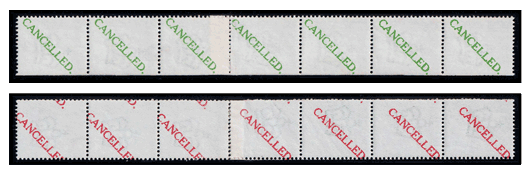
Coil Joins
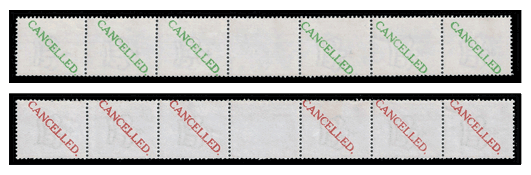
Inter-pane Gutters
The Crown watermark paper was overprinted CANCELLED Type 21 in green to simulate ½d stamps, and in red for 1d stamps. Rolls were made from strips of 21 labels as the inter-pane gutter label was left in place. This extra label was unwatermarked and was not cancelled. The watermark can be seen showing through in the images above.
Second Trial
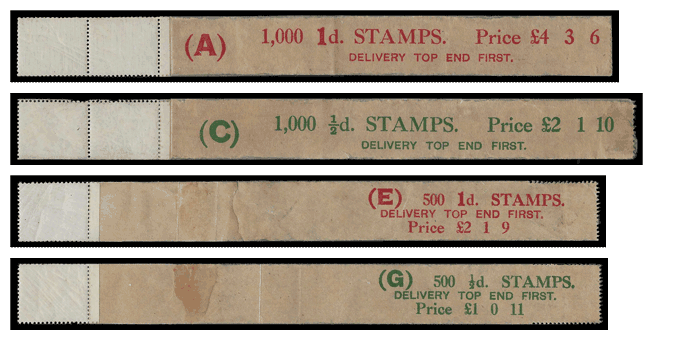
There was a second trial in December 1911 responding to suggestions from the first trial. There were 40 rolls, ten of each (ACEG) made up with blank labels watermarked “Cooper”. The watermark only shows on some labels, most are unwatermarked. The gum was thick, and examples show gum-creasing. The leaders were the same as issued rolls, perforated gauge 11 at the right on rolls of 1,000 and perforated 15×14 at the right on rolls of 500, and all with delivery method Top End First. Two sets of these trials are known.
Following this trial, roll production started in May 1912, and rolls were issued for use in stamp affixing machines in September 1912.
1½d Trial

There was a further trial in 1918 made up with (M) leaders and blank unwatermarked labels. These are said to have been made in preparation for the issue of 1½d rolls, needed for the June 1918 postal rate increase. However, the four new rolls (JKLM) were initially printed at face value in error. The (M) roll was printed with £3.2.6 but this trial is printed with £3.2.7. Also, the label is attached gum-side facing out, which is the wrong way around for affixing rolls. Perhaps this was a trial for 1½d vending machine rolls? Several examples of this trial are known.
Rolls with blank labels continued to be made in later years, but the purpose of these rolls was to test vending machines rather than testing the manufacturing process.
Next: Downey Head