
Many different testing, demonstration, and advertizing labels (also known as dummy stamps or trade labels) were made by all companies involved in the production of rolls and the machines that used them. They are presented here in three broad groups:
• Labels made by the printers for production trials.
• Labels supplied to the Post Office to test vending machines.
• Labels used to promote affixing and vending machines.
The last group includes US labels as several machines manufactured in the US were sold through agents in the UK, Multipost being the most successful.
Production Trial Labels
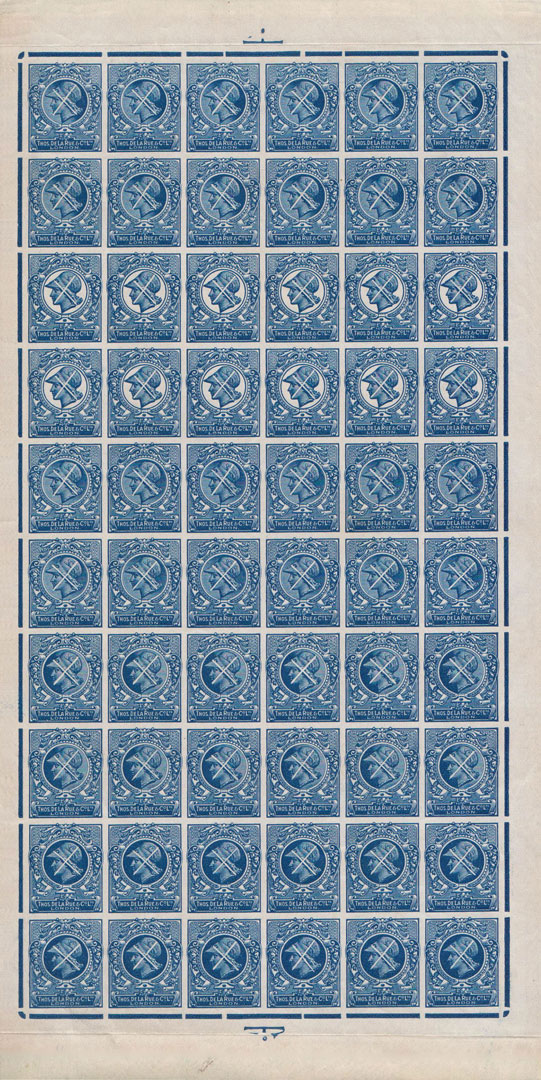 Plate of 60
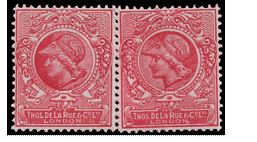
The helmeted head of Britannia, facing left (often called Minerva head), with “THOS. DE LA RUE & Co. Ltd. / LONDON”. Trial coil join shown c.1907 printed in red on gummed perforated paper. These De La Rue dummy stamps are known in a wide range of colours and styles. The plate of 60 shown (click the thumbnail) has different background shading on each pair of rows. They are also said to have been used by Harrison to test affixing machines, which is curious. Also known with “MACHINES SPECIALES / L. CHAMBON”.
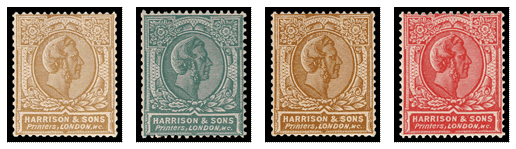
The head of Thomas Richard Harrison, facing right, with “HARRISON & SONS / Printers, LONDON, WC” printed in bistre, grey-green, brown, or red on gummed perforated paper. Used for production trials c.1910.
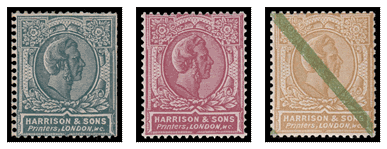
As above, but in dull blue, purple, and bistre. Used for production trials c.1910; the bistre with a diagonal green line in booklet trials c.1912.
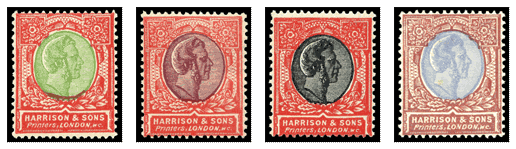
Also known as a bi-colour stamp in red/green, red/purple, red/black, or brown/blue.
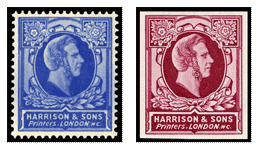
The same design was later used to promote photogravure in blue or purple, c.1935.
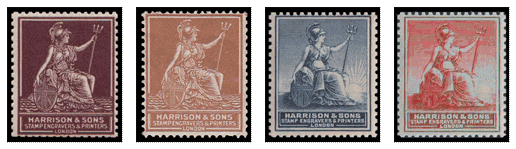
Britannia seated, facing right, with “HARRISON & SONS / STAMP ENGRAVERS & PRINTERS / LONDON” printed in purple-brown or light brown on gummed perforated paper with Harrison’s house watermark, used in production trials c.1911. Also known in red and blue with a rising sun design.
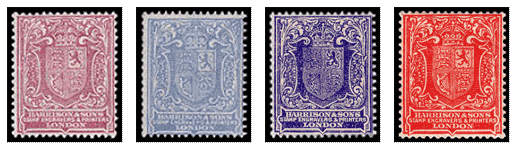
Coat of arms with “HARRISON & SON / STAMP ENGRAVERS & PRINTERS / LONDON” printed in mauve, pale blue, violet, red, black, or green on gummed perforated paper with Harrison’s house watermark. c.1912. Also known in imperial red with “PATRIOTS, / MAINTAIN THE / UNION !”.
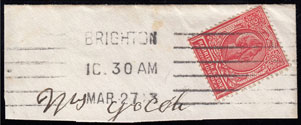
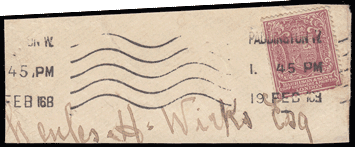
Production trial labels used postally.
Testing Labels
In 1911, before the first issue of Post Office rolls, there were trials using Crown watermark paper overprinted CANCELLED, and blank labels watermarked “Cooper”. These are described here: Trial Rolls
After the trials, rolls with blank labels continued to be made, but the purpose of these later rolls was to test vending machines rather than testing the manufacturing process. Blank labels are known without watermark, with Harrison’s house watermark, and with “Croxley Script Extra Strong”.
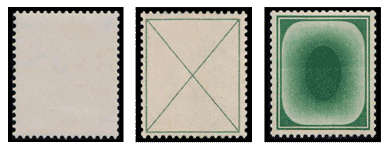
There were complaints that the blank labels were not satisfactory, and it was suggested to print the labels with a stamp size rectangle. In June 1935, Harrison was instructed to print 3,100 rolls of 960 labels with a rectangle and a cross in green. They used gummed perforated paper without watermark.
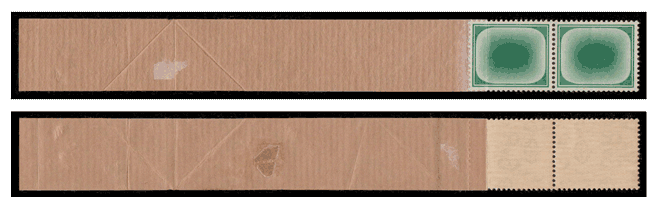
The rectangular design was also not satisfactory, and Harrison submitted a “Poached Egg” design in December 1935 (the official name was the “Target” design). Harrison was instructed to print 2,000 rolls of 960 labels on gummed perforated paper with GvR Block Cypher watermark. There was a second order for about 11,000 rolls. These were only used for a short period in 1936, but many more of these exist today than the preceding design, all leaked from the Post Office. As these were for vending machines, stamps were wound lengthways, facing inwards. Leaders were unprinted brown paper. The images above show the inside and outside of a leader. (An image with “TEST ROLL. No. 1” printed in red, originally from a post on stampboards.com, is fake.)
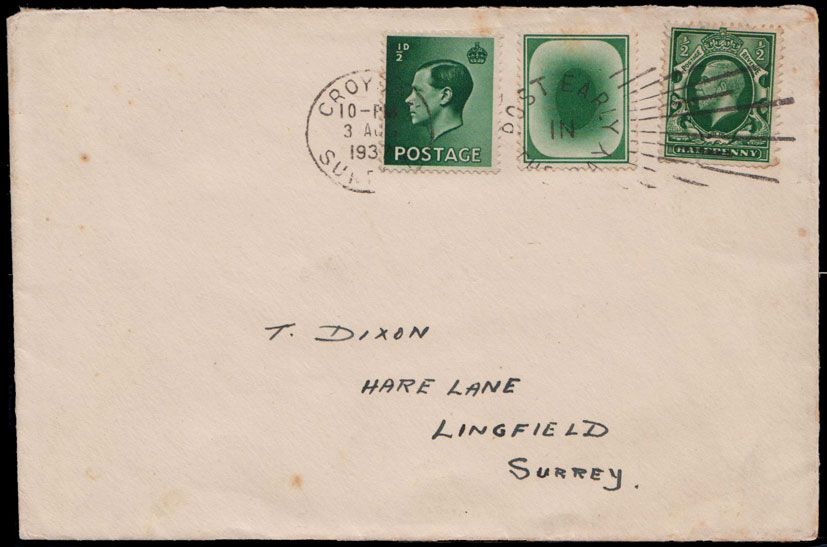
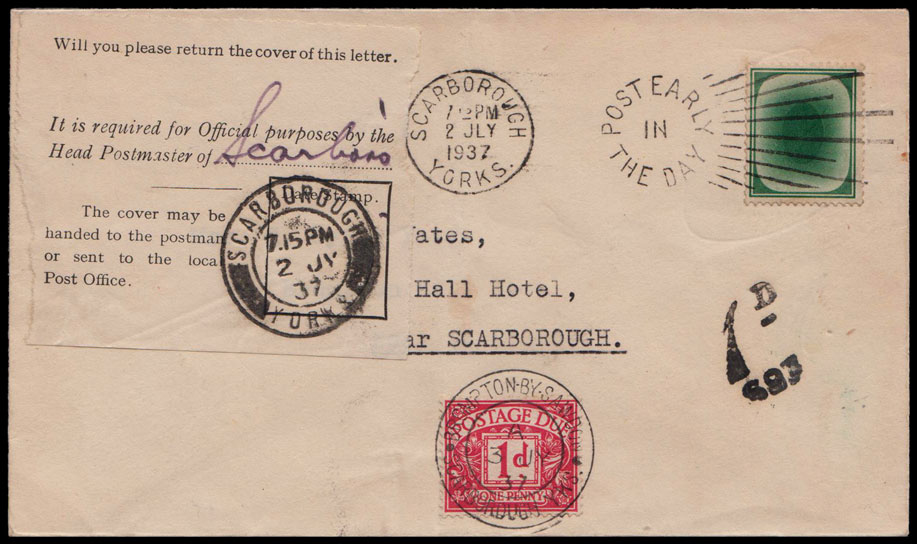
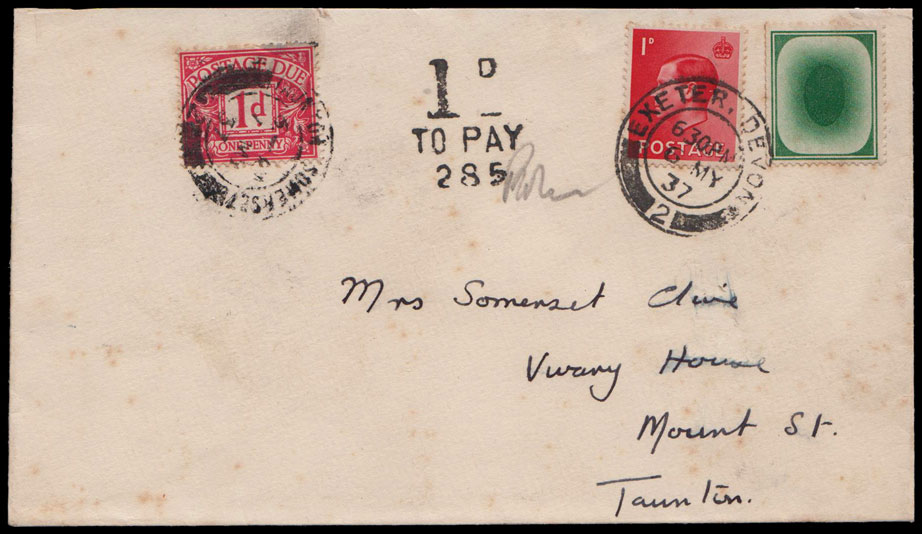
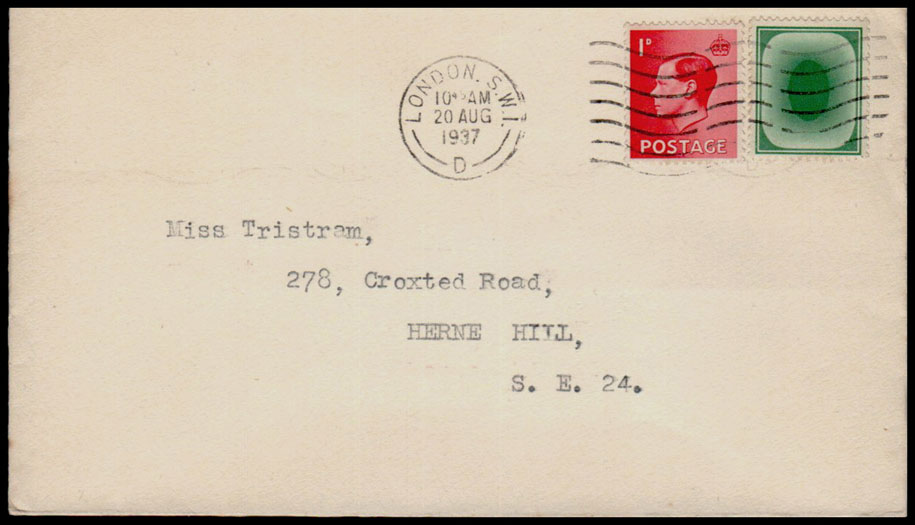
Click the images to enlarge.
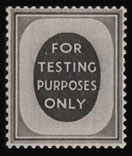
1937
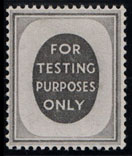
1938
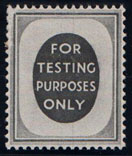
1954
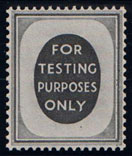
1955
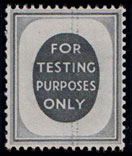
1958
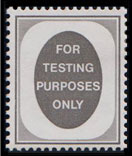
1967
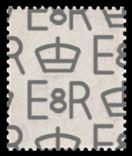
E8R
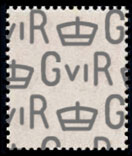
GviR
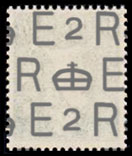
Tudor
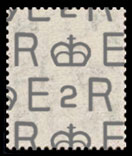
Edward’s
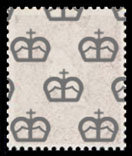
Crowns
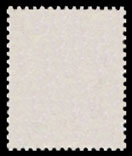
none
In 1937, after too many green eggs had been used to pay postage, a new label in grey was designed by Mr Dell of the Post Office Stores Department, the FTPO (For Testing Purposes Only) label. This design had staying power and can be found with various watermarks: E8R, GviR, Tudor Crown, St. Edward’s Crown, and Multiple Crowns. In 1967, an updated design without watermark came along with the Machin issues.
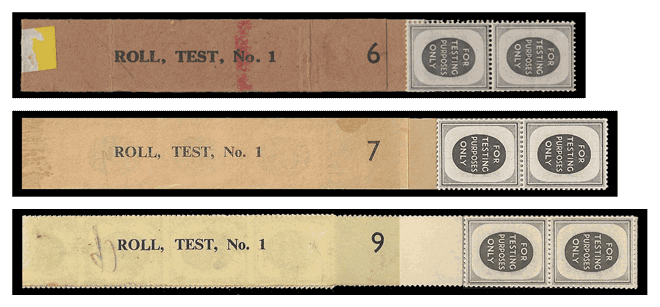
Test roll leaders are known in different formats. The first King George VI leader above is made from thick dark brown paper, it has a yellow sealing strip, and the text is 45mm long. This setting is thought to have been used up to and including the St. Edward’s Crown labels. The other two leaders are made from plain buff paper and from cream/white perforated watermarked paper. Both have 41mm text and labels with the Multiple Crowns watermark.
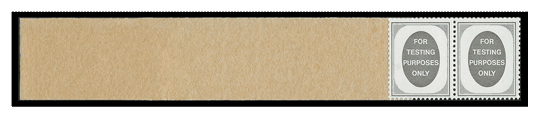
The introduction of sideways vended rolls in 1969 led to sideways test rolls. Similar to the large GL rolls, these test rolls had 3,000 labels wound sideways, facing inwards, for delivery left side first. It has been said that “No. 1” referred to endways rolls, and “No. 2” to sideways rolls, but this terminology was only used internally, “No. 2” does not appear on the leaders. Leaders were unprinted brown paper. (An image with “ROLL, TEST 2.”, originally from a post on stampboards.com, is fake.)
FTPO Varieties
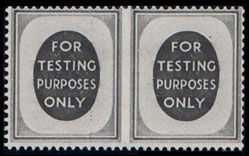
1957
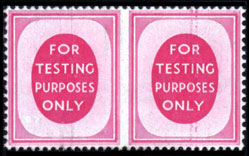
1964
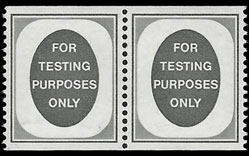
1969
In 1957, a double width version with watermark St. Edward’s Crown was used to test the First Day Cover machines at the Boy Scout Jubilee Jamboree. In 1964, a pink version of this label with watermark Multiple Crowns (from sheets, not rolls) was included in the Philatelic Bulletin. In 1969, early sideways test rolls were delivered with imperforate edges. They were considered not acceptable.
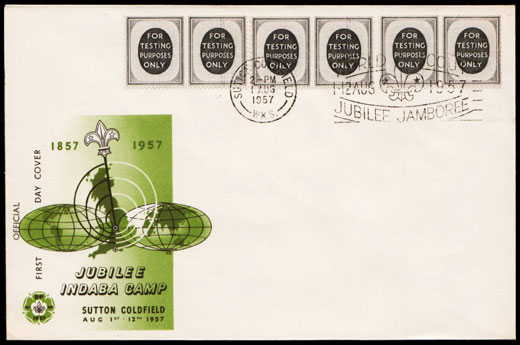
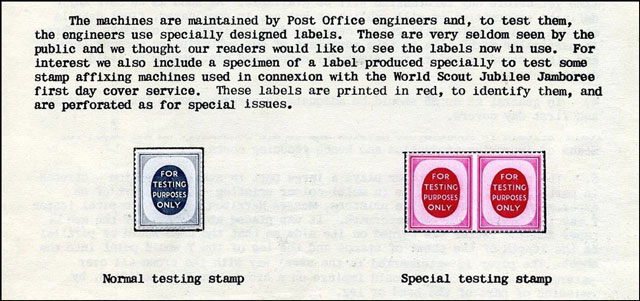
Click the images to enlarge.
Demonstration Labels
Affixing & Vending machine manufacturers had their own labels to demonstrate their products.
Generally, labels for the UK market were perforated 15×14 but those for the US market were only perforated between labels leaving the other two sides imperforate. Of the affixers sold in the UK (Fixo, Lightning, Multipost, National, Poko, Standard), Fixo dominated handhelds during the 1910s, then Multipost in the 1920s (after the introduction of sideways rolls), and Poko dominated the desktop market.
UK Demonstration labels
Of the UK labels below, Fixo and Multipost were printed by Harrison & Sons, but little is known about the printers of the other labels. Desborough (1921) in a section on Stamp Affixing Machines says “Dummy rolls of stamps on which any printed matter is inserted can be supplied by Messrs Allchin Ltd, 28 England’s Lane, Hampstead, London. This address is now Allchin Pharmacy, but a 1914 trade directory lists Sidney Allchin & Co under the heading Postage Stamp Perforators. Sidney Allchin was also a sub-postmaster at that address. Given the similar designs of Brooker’s, Lightning, and Standard, we can speculate that Allchin was involved.
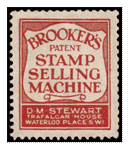
Brooker’s (London): c.1924 “BROOKER’S PATENT STAMP SELLING MACHINE” in red.
Brooker Automatic Vending Machines Ltd, 3 London Wall Buildings, London EC.
Four vending machines at Wembley in 1924 were “licensed to Messrs Brooker”.
Directors: D M Stewart, Henry Brooker, E J Halsey.
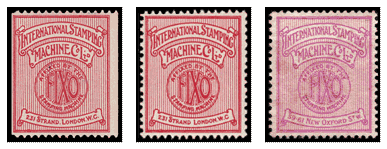
Fixo (London): “AFFIXED BY THE (FIXO) STAMPING MACHINE” in red or pink.
International Stamping Machine Co Ltd.
c.1911 in red at 231 Strand, London WC.
c.1913 part imperforate, possibly for the US market.
c.1915 in pink at 59-61 New Oxford St. W.
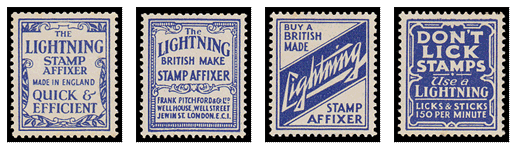
Lightning (London): c.1933 in blue.
Frank Pitchford & Co Ltd, 11 Well Street, London.
“BUY A BRITISH MADE / LIGHTING / STAMP AFFIXER”, or
“THE LIGHTNING STAMP AFFIXER / MADE IN ENGLAND / QUICK & EFFICIENT”, or
“THE LIGHTNING BRITISH MAKE STAMP AFFIXER / FRANK PITCHFORD & Co.”, or
“DON’T LICK STAMPS / USE A LIGHTNING / LICKS & STICKS 150 PER MINUTE”.
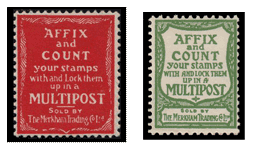
Multipost (Rochester, NY): c.1910-1930 in red or green.
UK agent: The Merkham Trading Co Ltd, 329 High Holborn, London.
“AFFIX and COUNT your stamps / MULTIPOST” in red.
ditto in green on a smaller insurance stamp.
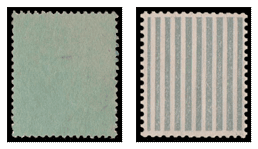
Poko (Germany): solid green or stripes (UK), green or blue (DE).
Deutsche Post und Eisenbahn Verkehrswesen AG.
UK agent: British Electric Automatic Machines (BEAM) Ltd, London.
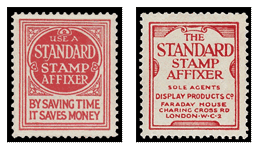
Standard (Somerville, MA): c.1927 in red.
UK agent: Display Products Co, Faraday House, Charing Cross Rd, London.
“USE A STANDARD STAMP AFFIXER” in red, or
“THE STANDARD STAMP AFFIXER CONTROLS THE STAMPS AND PREVENTS PILFERING”. or
“THE STANDARD STAMP AFFIXER / SOLE AGENTS / DISPLAY PRODUCTS Co. / LONDON”, or
“DON’T LICK STAMPS / USE A STANDARD / LICKS & STICKS 150 PER MINUTE”.
US Demonstration labels
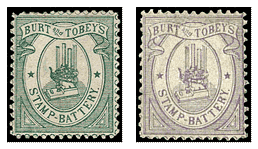
Burt and Tobey’s (New Bedford, MA): c.1890 the “STAMP-BATTERY” in green or lilac.
Henry P Burt and Charles W Tobey, 23 Middle Street, New Bedford, Massachusetts.
(Manufacturers of Electrical Specialties.)
Kendall: see Puritan.
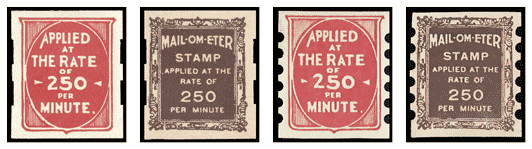
Mail-om-eter (Detroit, MI): c.1907 in red and brown.
Earlier as Schermack, later as Mail-O-Meter.
“APPLIED AT THE RATE OF 250 PER MINUTE.”, or
“MAIL-OM-ETER STAMP APPLIED AT THE RATE OF 250 PER MINUTE”.
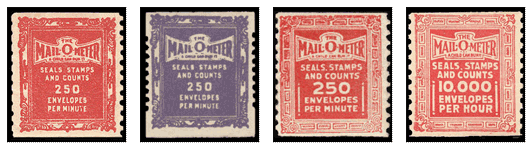
Mail-O-Meter (Detroit, MI): c.1922 in red or deep purple.
Earlier as Schermack and Mail-om-eter.
“THE MAIL-O-METER / SEALS, STAMPS & COUNTS 250 ENVELOPES PER MINUTE”, or
“THE MAIL-O-METER / SEALS, STAMPS & COUNTS 10,000 ENVELOPES PER HOUR”.
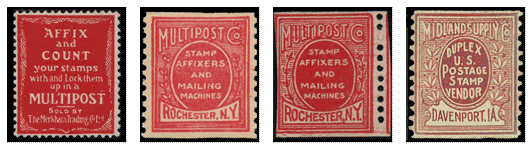
Multipost (Rochester, NY): c.1910-1930 in red.
“MULTIPOST Co / STAMP AFFIXERS AND MAILING MACHINES / ROCHESTER, NY” in red.
“MIDLAND SUPPLY Co” 209 E. Second St, Davenport, IA.
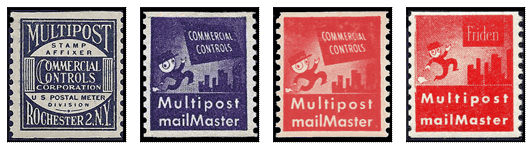
Multipost (Rochester, NY): c.1940-1950.
Company sold to National Postal Meter in 1941,
became Commercial Controls in 1944, sold to Friden in 1957.
“MULTIPOST / COMMERCIAL CONTROLS CORP / ROCHESTER 2, NY” in blue or black.
“COMMERCIAL CONTROLS / Multipost / mailMaster” in purple or red.
“Friden / Multipost / mailMaster” in red.
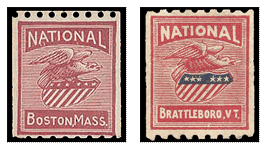
National (Boston, MA):
c.1911 as National Envelope Sealing & Stamping Machine Co. “Boston, Mass” in red.
c.1914 as National Automatic Machine Co. “Brattleboro, VT” in red & blue.
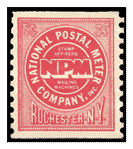
National Postal Meter (Rochester, NY): c.1920-1940 in red.
Company became Commercial Controls in 1944.
“STAMP AFFIXERS / NPM / MAILING MACHINES”.
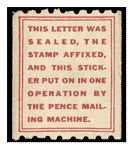
Pence (Minneapolis, MN): c.1914 in red.
The Pence Mailing Machine Co.
Peerless: see Puritan.
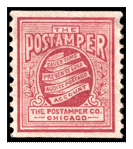
Postamper (Chicago, IL): c.1913 in red.
“THE POSTAMPER / SAVES TIME / PREVENTS LOSS / AUDITS POSTAGE ACCOUNT”.
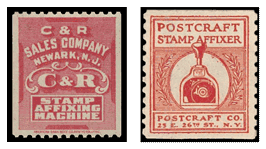
Postcraft (New York):
c.1909 as C & R Sales Co.
c.1914 with “POSTCRAFT STAMP AFFIXER” in red.
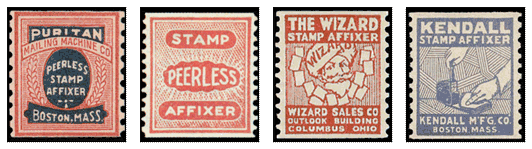
Puritan (Boston, MA): c.1913 in red and black.
Later as Peerless, then Wizard, then Kendall.
c.1913 “PURITAN / PEERLESS STAMP AFFIXER / BOSTON, MASS.”,
c.1914 “STAMP / PEERLESS / AFFIXER”
c.1915 “THE WIZARD STAMP AFFIXER” in red.
c.1917 “KENDALL STAMP AFFIXER” in blue.
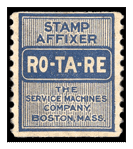
RO-TA-RE (Boston, MA): c.1920 in blue.
“STAMP AFFIXER / RO-TA-RE / THE SERVICE MACHINES Co”.
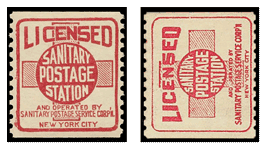
Sanitary Postage Station (New York): c.1926 in red.
“Licensed / and Operated by / Sanitary Postage Service Corp’n / New York City”.
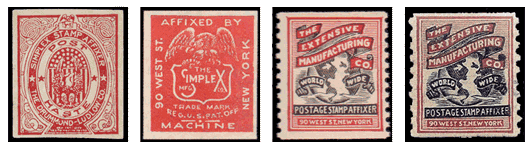
Simplex (New York): made in Thompsonville, Connecticut.
c.1909 distributed by Drummond-Ludlow, NY.
c.1910 by Simplex NY, an eagle on “THE SIMPLEX” in red or green.
c.1911 as World Wide affixer by the Extensive Manufacturing Co.
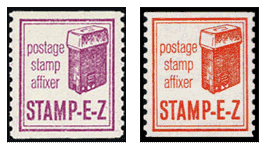
Stamp E-Z / Postafix (San Diego, CA): c.1965 in purple or red.
Data Link Corporation “postage stamp affixer STAMP-E-Z”.
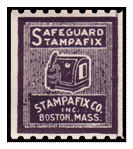
Stampafix (Boston, MA): c.1911 in purple.
“SAFEGUARD/STAMPAFIX / STAMPAFIX CO. INC. / BOSTON, MASS”.
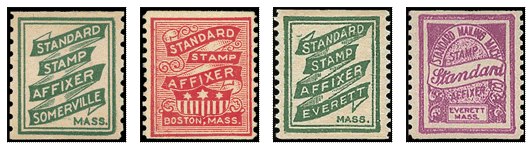
Standard (Somerville, MA):
Standard Stamp Affixer Co in Somerville, then Boston, MA.
Later as Standard Mailing Machines Co, Everett, MA.
c.1912 in Somerville, Mass.
c.1915 in Boston, Mass.
c.1919 in Everett, Mass.
c.1923 as Standard Mailing Machines Co.
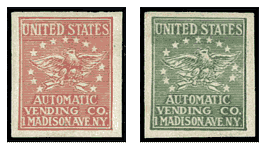
US Automatic Vending Co (New York): c.1909 in red or green.
“UNITED STATES AUTOMATIC VENDING CO. 1 MADISON AVE. NY.”
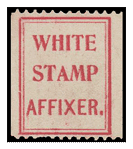
White (Providence, RI): c.1910 in red.
Samuel B White, Office Appliance Manufacturing Co.
“WHITE / STAMP / AFFIXER.”
Wizard: see Puritan.
World Wide: see Simplex.